Replacing a gas furnace should not begin by reading the BTU number on the old furnace and ordering the same size. A proper replacement starts with the house: its heat loss, windows, doors, insulation, basement or crawlspace, duct system, gas piping, venting and airflow.
That is the difference between changing a box and designing a heating system.
“Replacing a furnace is a technical art and skill with many disciplines. The goal is to solve the client’s comfort concerns and install a system that has the best chance of delivering long, dependable service when it is commissioned and maintained correctly.”
— Steven McKeon, Owner, Metro HVAC
What actually happens during a proper gas furnace replacement?
The physical removal and installation are only part of the job. ACCA’s retrofit design guidance starts with a load calculation, moves to equipment selection, evaluates the existing air-distribution system and finishes by commissioning the completed system.
Step 1: size the furnace from the house — not the old nameplate
Metro HVAC uses ScanPlan HVAC, a LiDAR-based field application, to measure the home and build the information needed for the heating and cooling load calculation. We capture room dimensions plus windows and doors, then account for the home’s insulation, attic, basement or crawlspace and other envelope factors.
The result is an estimate of the home’s actual heat loss and heat gain. That number is what should guide equipment selection — not simply the BTU rating of the furnace being removed.
The old furnace can be wrong
Copies an old decision without proving that decision was correct.
Starts with what the home actually needs and then selects equipment from that load.
Metro field observation: Steven estimates that roughly 9 out of 10 existing gas furnaces Metro evaluates are oversized. That is Metro’s field experience, not a national industry statistic. Many of the homes we work in contain equipment installed decades ago, when detailed residential load calculations were less consistently performed.
Oversizing is not automatically “extra comfort.” Oversized equipment can short-cycle, create larger temperature swings, increase starting/stopping stress and make it harder for the system to spend long periods operating at its most comfortable stage.
Step 2: make sure the ductwork can handle the new furnace
A furnace is an air-moving appliance as much as it is a gas-burning appliance. Modern high-efficiency furnaces can require substantial airflow in heating mode, and the existing duct system has to support that airflow without excessive static pressure.
That means Metro looks at the return-air drop, supply trunk, branch ducts, filter resistance, furnace blower capability and expected CFM. We regularly increase undersized cold-air drops rather than connecting a new furnace to a return system that can starve the blower and heat exchanger for air.
Metro commonly installs a 5-inch media filter in a side-mounted Ultravation cabinet. The goal is not just better filtration; the larger filter area also helps reduce unnecessary restriction compared with forcing the system to breathe through an undersized filter setup.
The supply side matters too. This becomes especially important on oil-to-natural-gas conversions. Many older oil-heated homes have six-inch branch ducts throughout the house. The new gas furnace, cooling system and ductwork all have to be evaluated together so the required CFM can actually get where it needs to go.

Step 3: choose the furnace type — 80%, 96%, two-stage or modulating
Efficiency and staging are separate decisions. The best choice depends on the home, the calculated load, existing venting, ductwork, budget and comfort goals.
80% AFUE furnace
AFUE is a seasonal efficiency rating. An 80% AFUE furnace converts about 80% of the fuel’s seasonal energy into useful heat for the home. It sends significantly more heat out with the exhaust than a condensing furnace and normally uses an approved metal venting system.
96%+ AFUE furnace
A high-efficiency furnace uses a secondary heat exchanger to pull additional heat from the combustion gases. That creates condensate and requires manufacturer-approved Category IV venting — commonly PVC/CPVC or another specifically approved material depending on the furnace instructions — for exhaust and often combustion-air intake.
Why Metro commonly recommends two-stage
Once the home is warm, it does not always need the furnace’s full firing rate to maintain temperature. On Daikin’s DM96VC two-stage furnace, low fire is about 70% of high-fire input. That allows longer, gentler operation during lower-load conditions instead of immediately going to full output every time.
What a modulating furnace does
A modulating furnace is closer to the gas pedal in a car. Rather than choosing only low or high fire, a communicating modulating furnace can vary its firing rate across a much wider range. Daikin’s DM97MC platform, for example, can modulate from roughly 35% to 100% of rated input, allowing the system to better match changing heating demand.
The goal is not simply to buy the furnace with the highest number on the brochure. It is to match the furnace, blower, duct system and controls to the home so the equipment can spend more time operating in the range that produces steady comfort.
Step 4: treat the gas line and shutoff as part of the safety system
Metro uses a combination of traditional hard-piped gas work and TracPipe flexible stainless-steel gas piping where it is appropriate for the installation. TracPipe is not a shortcut: it still has to be correctly sized, supported, connected, tested and bonded in accordance with the manufacturer’s instructions and applicable code.
Why flexible stainless gas piping can be useful
Unlike a completely rigid run, CSST provides flexibility that can accommodate normal building movement and certain seismic movement differently than rigid piping. That does not make a gas system rupture-proof, but it is one reason flexible gas-piping systems are useful when properly designed and installed.
Why Metro prefers easy-to-use shutoffs
Gas appliances require an accessible, approved shutoff valve. Where appropriate, Metro prefers a lever-style quarter-turn valve because the homeowner or technician can immediately see how to isolate the appliance without searching for a wrench.
Older systems sometimes have small brass gas cocks that are difficult to identify or operate quickly. We would rather leave the mechanical room with an obvious, accessible shutoff arrangement that makes future service and emergency isolation straightforward.
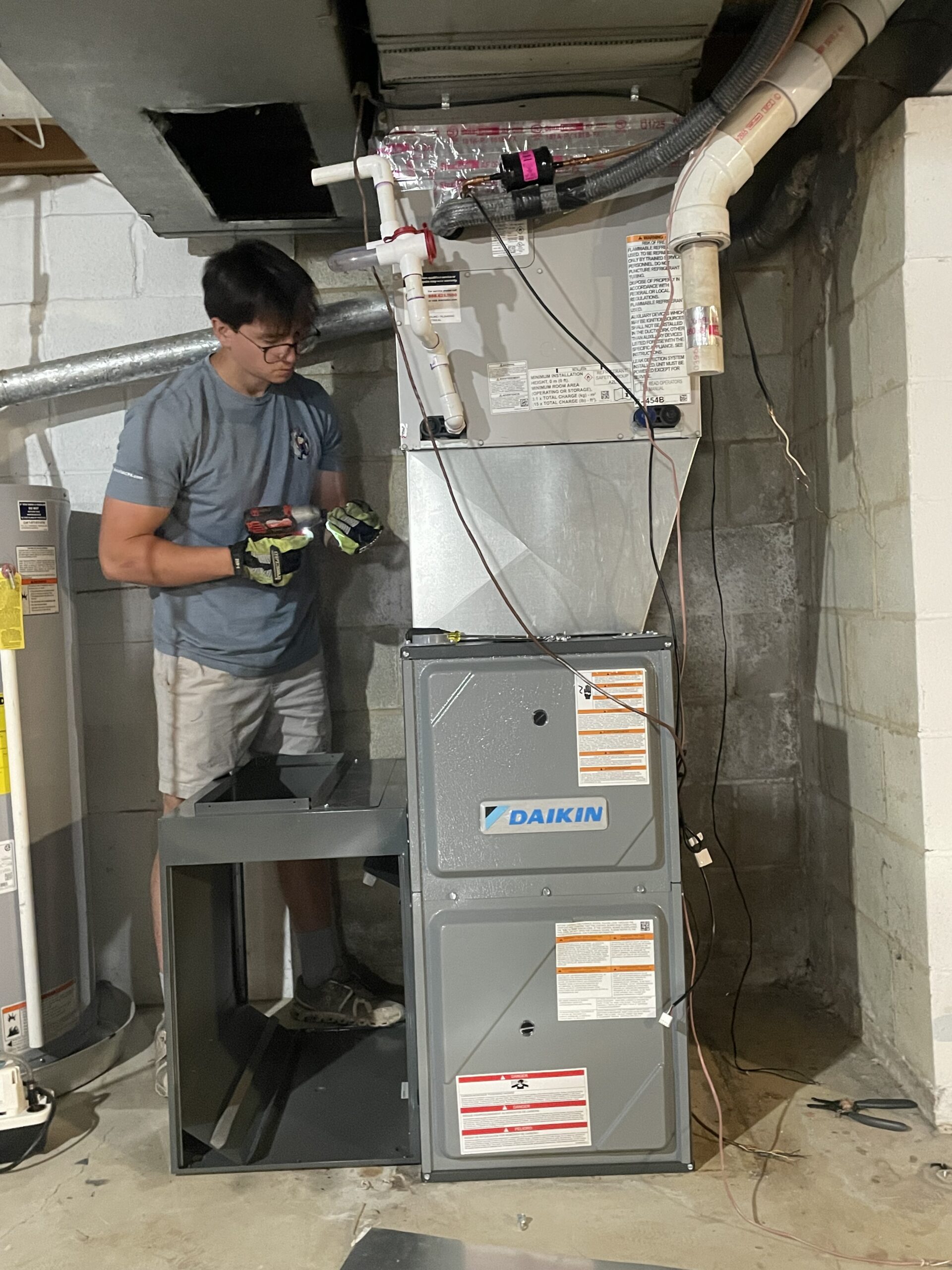
Step 5: high-efficiency furnaces change the venting and condensate system
A condensing furnace extracts enough heat from the flue gases that water vapor condenses inside the appliance. That is why a 90%+ furnace has a secondary heat exchanger and a condensate system, and why its venting requirements are different from an 80% non-condensing furnace.
Metro checks vent diameter, equivalent length, termination location, pitch, combustion-air configuration where used, furnace trap and condensate drainage against the actual manufacturer installation instructions for the selected model. We do not treat PVC venting as “just run two pipes outside.”
Step 6: commissioning is where the installation gets proven
The job is not complete because the thermostat turns the burners on. Commissioning is how we verify that the installed furnace is actually operating inside the conditions it was designed for.
Metro measures system static pressure, checks gas pressure at the gas valve while firing, and uses a combustion analyzer to evaluate how the furnace is burning. We also test condensate operation and confirm that venting is installed and operating according to the manufacturer’s requirements and recommended installation practices.

Before you approve a gas furnace replacement, ask these questions
- How are you calculating the heating load instead of copying my old furnace size?
- Will you evaluate the existing return and supply ductwork for the new furnace’s airflow?
- How will you verify total external static pressure after installation?
- Does my return-air drop and filter cabinet have enough area for the required CFM?
- How are the gas piping and appliance shutoff being sized and installed?
- If this is a condensing furnace, how are the intake, exhaust and condensate being designed?
- Will you measure gas pressure with the furnace actually operating?
- Will you perform combustion analysis and document that the system is operating correctly?

A furnace replacement is a system-design job
A furnace should be selected from the home’s load, connected to ductwork that can carry the required airflow, supplied by a properly designed gas system, vented exactly as the manufacturer requires and then commissioned with measurements.
That is how Metro approaches furnace replacement in Camp Hill, Mechanicsburg and the surrounding Central Pennsylvania area.
Related Metro HVAC resources
If you are deciding whether the existing furnace should be repaired or replaced, start with our furnace repair information and our furnace replacement page. You can also see an authentic Daikin furnace replacement project in Camp Hill and compare broader Metro HVAC replacement options.
Planning a furnace replacement?
Metro HVAC can evaluate the home, calculate the load, inspect the duct system and explain the furnace options before you decide what belongs in your house.
Technical reference points: ACCA residential retrofit guidance for Manual J / Manual S / Manual D methodology; U.S. Department of Energy guidance on furnace AFUE and condensing furnaces; Daikin published DM96VC and DM97MC specifications; and TracPipe published design and installation instructions. Equipment-specific requirements vary by model and installation, so manufacturer instructions and applicable codes always govern the final installation.