

Repair • Replacement • Tankless • Hybrid
Water Heater Repair & Replacement in Camp Hill, PA
No hot water or a leaking water heater? Request a diagnosis and clear repair options before approving work. Planning an upgrade? Metro HVAC diagnoses and repairs water heaters, replaces gas and electric tank systems, installs tankless equipment, evaluates tank-to-tankless conversions, and helps homeowners compare hybrid heat-pump options across Camp Hill and Central Pennsylvania.
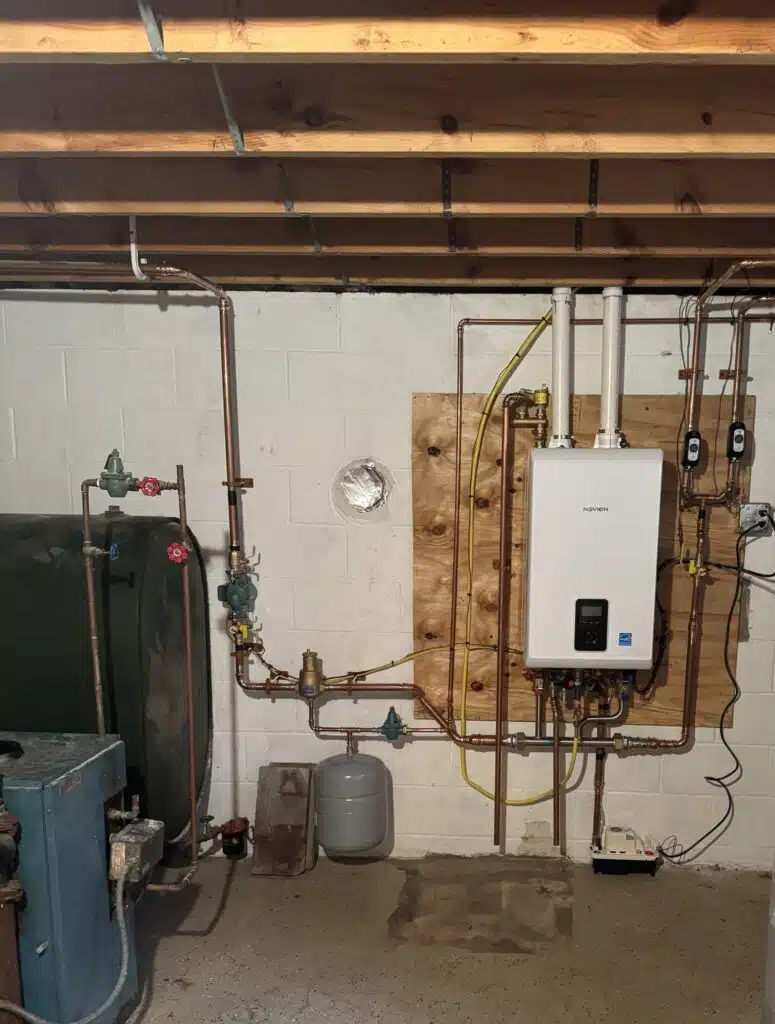
What Metro HVAC provides
Water heater services built around the actual problem
The right solution may be a targeted repair, a like-for-like replacement, a higher-capacity tank, a tankless conversion, or a hybrid system. Metro evaluates the existing equipment and home before recommending a path.
Water Heater Repair
Diagnosis for no hot water, lukewarm water, nuisance shutdowns, unusual sounds, ignition faults, element or thermostat problems, leaking valves, and control issues.
Request repairTank Water Heater Replacement
Gas, propane, and electric storage-water-heater replacement with capacity review, piping evaluation, safe venting or electrical connections, startup, and disposal of the old unit.
Compare planning pricesTankless Water Heaters
Replacement of existing tankless systems and tank-to-tankless conversions, including flow-rate sizing, temperature-rise review, gas or electric capacity, venting, condensate, and service access.
Read the tankless guideHybrid Heat-Pump Water Heaters
Evaluation and installation where room volume, ambient temperature, condensate drainage, electrical service, noise, and recovery needs make a hybrid system a practical fit.
See replacement rangesProtection & Piping Upgrades
Expansion tanks, shutoff valves, drain pans, relief-valve discharge piping, gas valves, vent corrections, condensate management, recirculation considerations, and pressure-related repairs when required by the system and scope.
Explore related plumbing servicesMaintenance & Descaling
Inspection, tank flushing or tankless descaling when appropriate, inlet-screen cleaning, leak checks, safety-device review, combustion or electrical checks, and maintenance guidance for the exact equipment.
Maintenance guidanceActive leak, gas odor, or water near electrical equipment?
Do not touch wet electrical equipment. If you smell gas, leave the area and contact the gas utility or emergency services from a safe location. If it is safe to do so, shut off the water supply to a leaking unit and call Metro. Do not plug, cap, or disable a temperature-and-pressure relief valve.
Choose the right system
Tank, tankless, or hybrid: what changes the decision?
There is no universal “best” water heater. The best fit depends on hot-water demand, available fuel, electrical capacity, installation location, venting, water quality, budget, and how the household uses hot water.
| Option | Often fits homeowners who… | Important planning checks | Watch-outs |
|---|---|---|---|
| Tank water heater | Want familiar operation, straightforward replacement, and stored hot-water capacity. | Tank size, first-hour delivery, fuel, venting or circuit size, space, drain pan, expansion control. | Finite stored supply, standby losses, and replacement is usually required if the tank shell leaks. |
| Tankless water heater | Want long-duration hot water, wall-mounted equipment, and on-demand operation. | Simultaneous GPM, winter temperature rise, gas/electric capacity, venting, condensate, recirculation, water quality. | “Endless” duration does not mean unlimited simultaneous flow; conversions can require infrastructure changes. |
| Hybrid heat-pump water heater | Have an appropriate installation area and want a high-efficiency electric option. | Room air volume, ambient temperature, condensate drain, sound, electrical supply, recovery profile, clearance. | Not ideal for every tight closet or cold space; placement and household demand matter. |
Not sure which path fits? Use Metro’s pricing tool for a planning range, then let us verify the existing fuel, capacity, venting, electrical service, water pressure, and installation conditions before the proposal is finalized.
Repair or replace?
We separate the failed part from the condition of the whole system.
A repair may be the right choice when the tank is sound, the problem is isolated, parts are available, and the expected repair life supports the cost. Replacement deserves consideration when the tank itself leaks, corrosion is advanced, failures repeat, capacity is no longer adequate, or the required repair approaches the value of a properly selected new system.
- Age, condition, leakage location, corrosion, and service history
- Hot-water capacity and recovery compared with household demand
- Gas combustion, venting, draft, electrical, thermostat, element, and control checks
- Water pressure, thermal expansion, relief-valve condition, and piping
- Repair cost, parts availability, warranty status, and expected remaining service life

Diagnosis before recommendation
Metro explains what failed, what is required for safe operation, and what is optional before you approve the work.
Installation quality matters
What a complete water heater installation should address
A low equipment price is not the same as a complete installation. The written scope should identify the system, accessories, corrections, protections, and testing included for the specific home.
Household size, fixture use, tub or shower demand, recovery needs, and simultaneous tankless flow.
Gas line and meter considerations, propane supply, circuit size, panel capacity, and required receptacles.
Approved vent material, route, clearances, combustion air, draft, terminations, and condensate for condensing units.
Shutoffs, unions or service valves, relief piping, expansion control, drain pan, recirculation, and water-pressure conditions.
Leak checks, temperature verification, burner or element operation, control setup, flow checks, and homeowner orientation.
Permit or inspection requirements, where applicable, are identified along with disposal, warranty registration, and exclusions.
Tankless conversion planning
Converting from a tank is a home-infrastructure decision.
A tankless unit is smaller on the wall, but the project can be larger than a standard replacement. Metro checks the full installation path before recommending a conversion.
- Winter incoming-water temperature and required temperature rise
- Peak simultaneous hot-water demand in gallons per minute
- Available gas input or electrical service capacity
- Venting, combustion air, sidewall termination, and clearances
- Condensate drain and neutralizer requirements for condensing units
- Service valves, descaling access, inlet filtration, and water quality
- Recirculation strategy and realistic wait time at distant fixtures
Maintenance and water quality
Scale, pressure, and neglected safety components can shorten service life.
Maintenance needs vary by manufacturer, fuel, water conditions, and equipment type. Metro can inspect the system and explain the interval and procedure for the exact model.
- Flush sediment from storage tanks when appropriate for the unit and condition
- Descale tankless heat exchangers based on manufacturer guidance and water quality
- Clean inlet screens and inspect isolation valves and relief devices
- Check venting, condensate, combustion, wiring, thermostats, elements, and controls
- Address excessive pressure or thermal expansion rather than repeatedly replacing relief valves
- Consider water treatment when hardness or scale is affecting fixtures and equipment
Installed price factors
What changes the price of a water heater project?
Metro’s instant tool provides a useful planning range. Final pricing depends on the equipment and the complete installation scope—not only the tank or appliance itself.
System type and capacity
Tank size, recovery, fuel, efficiency, tankless input, simultaneous flow, recirculation, and hybrid recovery needs.
Existing infrastructure
Gas line, vent, circuit, panel, drain, water piping, shutoffs, pressure, expansion control, access, and relocation.
Required corrections
Drain pan, relief discharge, venting, condensate neutralizer, gas valve, electrical disconnects, supports, and code-related items.
Site access and removal
Stairs, tight closets, finished areas, attic or crawlspace work, equipment weight, protection, and disposal.
Warranty and serviceability
Manufacturer coverage, registration, parts access, isolation valves, clearances, and maintenance requirements.
Permits and inspection
Local requirements differ. The written proposal should identify known permit, inspection, and coordination items.
Homeowner questions
Water heater FAQs
Do you repair both gas and electric tank water heaters?
Yes. Metro diagnoses common gas, propane, and electric storage-water-heater problems, including ignition and gas-control issues, thermostats, heating elements, wiring, leaking valves, relief devices, venting concerns, and insufficient hot water. A leaking tank shell normally requires replacement rather than repair.
Do you install tankless water heaters?
Yes. Metro replaces existing tankless units and evaluates tank-to-tankless conversions. The conversion review includes flow demand, winter temperature rise, fuel or electrical capacity, venting, condensate, water quality, service access, and recirculation considerations.
Does tankless mean unlimited hot water?
A properly sized tankless unit can provide hot water for a long duration, but every unit has a maximum flow and heating capacity. If simultaneous demand exceeds that capacity, outlet temperature or flow can be affected. Correct sizing is based on peak flow and temperature rise—not only household size.
How do I know whether to repair or replace my water heater?
Metro considers the exact failure, tank condition, leakage location, corrosion, age, repair history, parts availability, capacity, safety, and repair cost. A sound tank with an isolated failure may justify repair. A leaking tank shell, repeated failures, severe corrosion, or inadequate capacity often supports replacement.
What size tank water heater do I need?
Tank sizing depends on household size, fixture use, large tubs or showers, simultaneous demand, fuel, recovery rate, and the unit’s first-hour delivery. Simply replacing the old tank with the same gallon size can repeat an existing capacity problem.
What is an expansion tank, and do I need one?
An expansion tank provides space for heated water to expand in a closed plumbing system. Whether one is required depends on the system configuration, pressure controls, backflow devices, local requirements, and manufacturer instructions. Metro evaluates the existing setup during replacement or pressure-related service.
Can hard water damage a water heater?
Mineral scale can reduce heat transfer, restrict tankless passages, create noise, and increase maintenance needs. The effect depends on hardness, temperature, usage, and equipment design. Water treatment may help where hardness is significant, but it does not eliminate manufacturer-required maintenance.
How often should a water heater be flushed or descaled?
The correct interval depends on the manufacturer, water quality, usage, and equipment condition. Storage tanks may need sediment flushing; tankless units may need periodic descaling and inlet-screen cleaning. Metro follows the instructions for the exact model rather than applying one universal schedule.
Will my gas water heater work during a power outage?
Some conventional gas tank models may operate without household power, while many modern power-vent, direct-vent, electronic-ignition, condensing, and tankless systems require electricity for controls, ignition, or fans. The answer depends on the exact equipment.
How quickly can Metro replace a failed water heater?
Scheduling depends on equipment availability, fuel type, access, required corrections, permits, and current workload. Metro prioritizes active leaks and no-hot-water calls when scheduling allows and will explain the earliest responsible path after reviewing the job.
Central Pennsylvania service
Water heater help from Metro’s Camp Hill team
Metro HVAC is based in Camp Hill and serves homeowners throughout the surrounding Cumberland, Dauphin, and nearby South Central Pennsylvania communities. Availability varies by project type and scheduling.
Choose the next step that fits
Need a repair now—or planning a replacement?
Schedule a diagnostic visit for a problem, or use the pricing tool to compare tank, tankless, and hybrid replacement paths before an in-home evaluation.
Local water-system service
Water heaters & water treatment by city
Metro’s city pages connect local homeowners directly to tankless installation, tank water-heater and water-treatment guidance.
