

A Navien tankless water heater can provide long-duration hot water without a large storage tank—but the right installation starts with your home’s demand, not a model number. Metro HVAC offers Navien tankless installation for homeowners in Camp Hill, Mechanicsburg, and nearby Central Pennsylvania. Our water-heater installation service evaluates the equipment and the work your home needs.
This guide answers ten practical buying and installation questions using Navien’s published product information. For the basics across all brands, start with our general tankless water-heater guide.
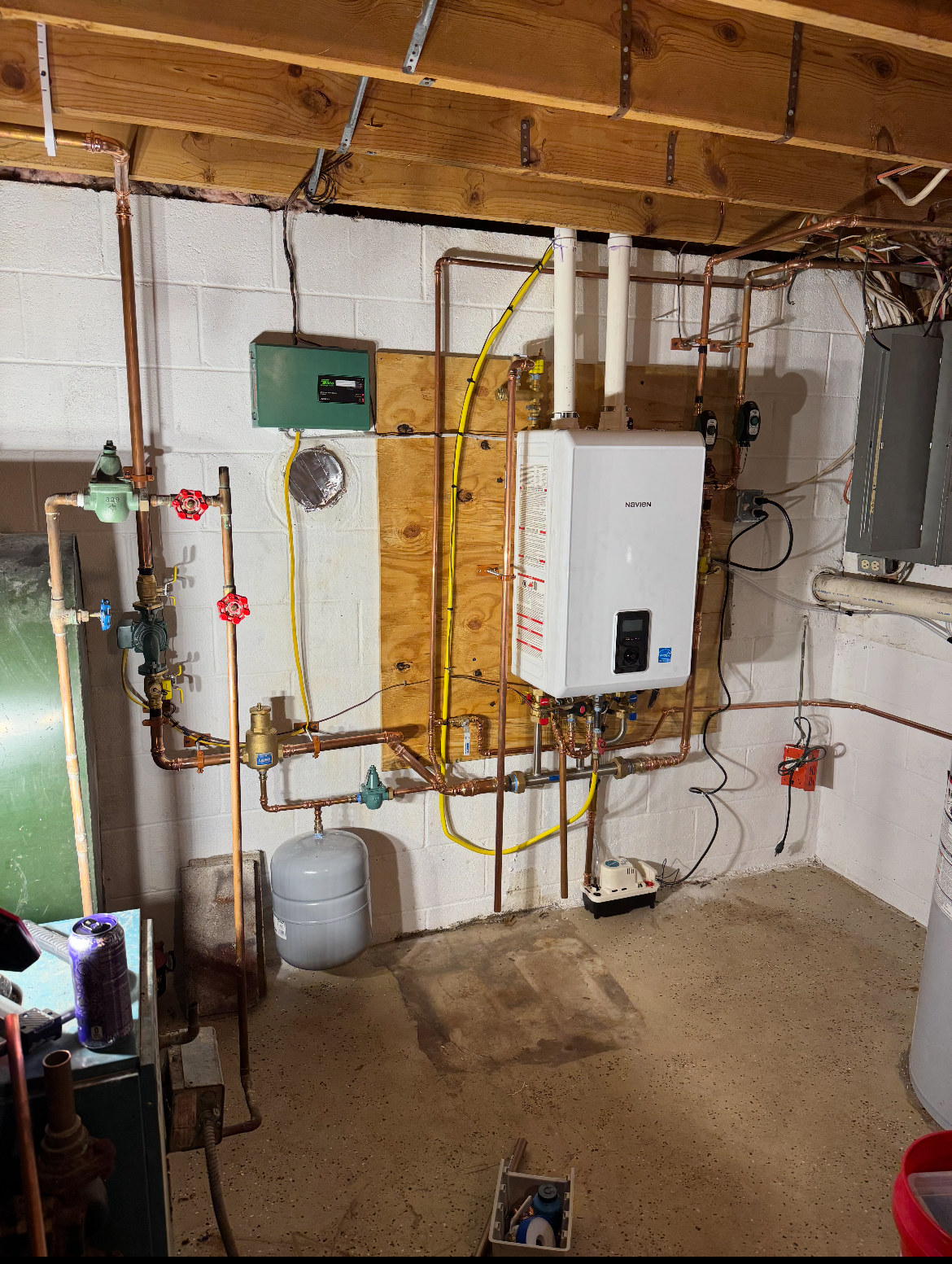
1. Which Navien tankless model should I consider?
Start by comparing the features you need, then confirm capacity. Navien’s NPE-A2 condensing series includes ComfortFlow, with a built-in recirculation pump and small buffer tank. The NPE-S2 series is a different configuration; recirculation requires additional equipment rather than the same built-in package.
Navien lists efficiency up to 0.95 UEF for NPE-A2 and 0.96 UEF for NPE-S2, depending on model. These are manufacturer lineup examples, not a promise that every model is stocked. Metro confirms the exact model, availability, and accessories in your proposal.
2. Do I need a Navien water heater or a combi boiler?
For showers and faucets, start with a domestic water-heating evaluation. For hot water plus compatible hydronic home heating, a combi boiler may be worth evaluating. Navien’s NCB-H and NFC-H combi families address both functions; heating-system water remains separate from water at your taps.
A combi selection requires both a home heat-loss calculation and a domestic hot-water demand review. It is not an automatic substitute for a furnace. Our boiler installation service covers that separate evaluation. Navien explains the two functions here.
3. What size Navien will work during a Central PA winter?
Size for simultaneous flow and temperature rise—not the biggest advertised GPM number. GPM means gallons per minute. Temperature rise is the difference between incoming cold water and the heater’s outlet temperature.
For example, 40°F incoming water heated to 120°F requires an 80°F rise. That is an illustration, not a measured temperature for your home. Navien’s published NPE-240A2 flow chart shows:
| Temperature rise | Hot-water output |
|---|---|
| 35°F | 11.2 GPM |
| 70°F | 5.6 GPM |
| 80°F | 4.9 GPM |
Source: Navien NPE-240A2 temperature-rise chart. Ratings are model-specific; actual sizing must account for your fixtures and installation.
4. Can one Navien run two showers without running out?
Possibly—if its output meets the combined demand at your required temperature rise. A tankless unit does not empty a large storage tank, but it still has a heating-capacity limit. Running showers and appliances together can exceed that limit.
Tell Metro which fixtures you actually use together, including large tubs or multi-head showers. The Department of Energy’s sizing guidance emphasizes peak flow and winter inlet-water conditions. Bathroom count alone is not enough.
5. Will an NPE-A2 give me instant hot water?
On-demand heating does not eliminate the pipe-travel delay. Water already sitting between the heater and faucet must move before newly heated water arrives.
The NPE-A2’s recirculation capability can help reduce waiting when correctly connected and configured. Navien describes options using a dedicated return line or compatible NaviCirc arrangement. A built-in pump alone is not a guarantee of instant hot water at every fixture. Ask which piping changes, accessories, and controls your estimate includes. See Navien’s recirculation explanation.
6. Can Metro reuse my existing gas line and vent?
Only after checking them against the chosen model and the home’s total requirements. A tank-to-tankless conversion may need gas-capacity corrections, different venting, condensate drainage, electrical work, or water-pipe changes. Condensing units require an appropriate condensate disposal arrangement.
Navien NPE models also need electricity for controls and operation; gas fuel does not make them power-outage independent. Do not assume a working old water heater proves its connections suit the replacement. DOE’s tankless-conversion guide explains these infrastructure considerations. Gas, venting, and electrical work belong with qualified professionals.
7. How much does Navien tankless installation cost?
The installed price depends on the complete job, not just the heater. Replacing an existing tankless unit can involve different work from converting a storage tank or relocating the appliance.
Ask for an itemized scope covering the selected model, gas and venting work, condensate handling, electrical supply, service valves, removal of old equipment, permits where required, and startup. Recirculation and water treatment should be clearly identified when included. Metro provides a project-specific written estimate; an equipment-only online price is not a quote for your home’s installation.
8. Will a high-efficiency Navien pay for itself?
Do not assume a guaranteed payback period. UEF—Uniform Energy Factor—is an efficiency comparison rating, not the percentage your household bill will fall.
Compare the proposed model with your current equipment, fuel prices, household usage, installation cost, and maintenance. Recirculation can improve convenience while adding energy use, so its controls matter. A properly selected tankless system may be attractive for comfort and space as well as energy performance. The DOE conversion guide discusses weighing upfront costs against operating benefits.
9. What maintenance does Navien need, and how long can it last?
Plan for regular professional care rather than treating tankless as maintenance-free. Navien’s homeowner guidance describes yearly descaling in many water conditions and service life of up to 20 years with proper maintenance. Neither is a universal guarantee for every home.
The exact model instructions, water hardness, usage, and condition determine the service plan. Discuss inlet-filter cleaning, scale removal, venting and condensate checks, and access for servicing. Where hardness is significant, Metro can evaluate water-treatment options; treatment does not replace required maintenance. Source: Navien’s homeowner FAQs.
10. What warranty and installation details should I get in writing?
Separate heat-exchanger coverage, parts coverage, and labor. Navien lists 15-year heat-exchanger, 5-year parts, and 1-year labor coverage for residential NPE-A2 applications using standard or controlled recirculation, subject to its warranty terms. Other applications can have different periods.
That is not a 15-year all-inclusive warranty, and it is not the warranty for the pictured combi boiler. Ask Metro to document the exact equipment, application, manufacturer’s terms, registration requirements, maintenance responsibilities, and any separate installation-labor coverage. Review Navien’s application-specific warranty table.
Get a Navien tankless installation estimate
Tell Metro about your existing water heater, fuel source, bathrooms, and when hot water falls short. We will evaluate the installation conditions and explain the appropriate Navien options for your home in Camp Hill, Mechanicsburg, or the surrounding service area.
Request a Tankless Installation Estimate
Use the water-heater service form and mention Navien tankless installation, or call 717-874-2030. Your appointment is confirmed by the office—not by reading this guide.
Published October 1, 2026. Product information was checked against Navien and U.S. Department of Energy sources linked above. Follow the instructions for the exact equipment selected.
